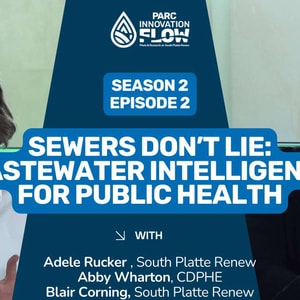
S2E2 -Sewers Don’t Lie: Wastewater Intelligence for Public Health
Transcript
All right, welcome, everyone, to the Innovation Flow podcast, where we talk about South Platte Radiance park program and innovations that are happening around here and throughout the water and wastewater industry. And today, I am happy to have two guests to talk about wastewater surveillance. We have Abby Wharton, who is the wastewater surveillance coordinator with cdphe, Colorado Department of Public Health and Environment. And we have Adele Rucker, laboratory manager at South Platte Renew, who manages the wastewater and environmental lab there. So thanks for being here today.
Speaker B:Thank you for having us.
Speaker C:Yeah, thanks for having us.
Speaker A:Right on. Well, maybe we just get started with some introductions. Why don't you go first, Abby, and tell the listeners who you are, a little background and anything else you want them to know. Yeah.
Speaker C:So, as Blair said, my name is Abby. I'm the wastewater Surveillance coordinator with cdphe. And before coming to cdphe, I did my bachelor's in biology and molecular biology at Miami University in Oxford, Ohio. And from there, I went on to Ohio State University, where I got my Master's of public health in epidemiology. Around the time that I had graduated with my master's, my partner and I decided to move out to Colorado. We were originally from Ohio, so we've been out here for a couple years now, and I was able to get this job when I came out, and it's been awesome.
Speaker A:Cool. What about. What do you like to do in your free time? Any hobbies that you like to do?
Speaker C:So I call myself a hobby cycler. I have a lot of hobbies, and I cycle through them throughout the year, so I'm a big reader. I love to crochet. We are big hikers and campers, hence part of the reason why we came out here. So we love to do that. And I also go to Pilates. I love Pilates. So just a lot of different hobbies.
Speaker A:Cool. Sounds like you're taking advantage of the Colorado lifestyle there.
Speaker C:Definitely.
Speaker A:Well, well. Cool. All right, Adele, how about you? I mean, I work with you every day, but pretend I don't and tell the listeners who don't work with you every day a little bit about yourself.
Speaker B:My name is Adele. I work here at SBR in the laboratory. I'm the lab manager. I've been in the industry for about 20 years. I originally started out in drinking water, and I worked there for just over 16 years, and I've been here at SBR for about five years. I've always been a lab rat. So whether it's drinking water or wastewater, I like being in the lab and working in the lab all Right.
Speaker A:Well, how about hobbies? Adele, what do you. What do you like to do in your free time?
Speaker B:I like to travel a lot. Specifically, I like to take cruises. And I like to make soap, which is a chemistry side hobby.
Speaker A:Yeah.
Speaker B:Because I make laundry soap. I make bar soap.
Speaker A:Wow. Where did you. When did you start doing that?
Speaker B:Been doing that for about 10 years now.
Speaker A:Oh, yeah. Nice. Soap making. I've never met anyone who made soap before. Yeah, now I know.
Speaker C:Do you sell it?
Speaker B:I used to like to my family, like to my aunt and my mom. But then I stopped for a while because of traveling, and I. So now when I make it, I only make small batches, and I'm like, no soap for you.
Speaker A:My wife's been making this stuff.
Speaker C:Was.
Speaker A:It's like this zinc ointment or something. Supposedly good for aches and pains, but there's always something bubbling on the stove. But anyway, let's get into the topic we're here to talk about today, wastewater surveillance. So, Adele, maybe can you give us a description of. For the listeners, what is wastewater surveillance? What are we talking about when we say wastewater surveillance? Or I've heard it called wastewater based epidemiology or different things. What are we talking about there?
Speaker B:So wastewater surveillance, it's a public health tool is essentially what it is. And it's where you can look for pathogens that come through the collection system and detect those in the wastewater. And so the good thing about it is it's community based and you can tell what the trends are without people having to go to the doctor. You can tell people have the flu or have whatever, because when you're sick, you might not feel like going to the doctor. So this is a way to where it's coming down the pipe and it'll be able to be detected in the system.
Speaker A:All right. And Abby, do you got anything to add? What kind of pathogens are we talking and what is the difference between. I know you're into epidemiology, so what are the other ways they look at diseases in communities versus this one?
Speaker C:Yeah, that's a great question. So some of the pathogens that we're talking about, we started with COVID 19. So that's really where wastewater surveillance took off in the United States. Specifically in the United States, because a lot of other countries were doing this for a lot longer than we've been. And then from there, our program specifically has grown a lot. And we now do surveillance for influenza A and B, RSB A and B. We also look at Mpox Clade 1 and Clade 2 measles. We also are looking at EBD 68 in wastewater. And along with that, we're piloting a couple projects.
Speaker B:So.
Speaker C:So we're piloting a project for West Nile virus detection in wastewater. We did this last year during the West Nile virus season. We plan to do it again this year. And then we're also piloting program for antimicrobial resistant gene targets. So we're looking to see if there's any AMR targets in the wastewater and then CRS as well. And then that piloting, that really just means that we're not putting that data publicly yet. We're trying to understand it, work with our SME teams within CDPHE and the experts who really understand those pathogens to see where wastewater surveillance can kind of fill in some of those gaps. So that's a little on, you know, what we've been looking at.
Speaker A:So started, yeah, started out of the COVID thing and it's just grown since there to where you're like, why don't we look for this? Why can't we look for this?
Speaker C:Exactly. So we're really looking at, you know, those infectious diseases, infectious pathogens or things with that public health concern. And we've just grown so much from where we started. It's been amazing to see how this program has been able to expand into other pathogens and really fill in some of those gaps.
Speaker A:Yeah. Well, cool. Yeah, that was my next question. How has it changed or evolved along the way? Has the testing. Are you still using the same type of testing that you did in the beginning, or has that changed at all? Or maybe take us through a little bit of how. But don't get too technical here because,
Speaker C:you know, well, I promise I won't get technical on the lab part of it. That's not my job. So I can keep that one pretty brief. But our program has changed so, so much in the last couple years. You know, we've been going for about five years now, and our program has really just expanded. So we started, like I said, during the COVID 19 pandemic, and this was in partnership with the Colorado State University lab, because at the time, the CDPHE lab didn't have the capabilities to do wastewater detection testing. So we were working with CSU and about 68 utilities in Colorado to work to surveil for COVID 19. Our lab became the first lab in the nation to create an analysis pipeline for wastewater sequencing data, which is really awesome. And then from there they were able to add on the capacity for wastewater Surveillance detection. So they added that capacity in, and we switched all sampling from CSU lab to the CDPHE lab. And they've been doing it ever since. In 2022, around August of 2022, the CDC designated CDPHE's Wastewater Surveillance Program as a National Wastewater Surveillance System center of Excellence. So that was a really cool designation for us. We were one of the first two centers of excellence in the nation. There are now six because the program has expanded so much since 2022. But really what this means is that is a partnership between the University of Denver, our wastewater utilities, and cdphe. And our intention is to grow and enhance and expand the National Wastewater Surveillance System across the US So the way we do that, we've been doing this for five years. We have learned so much in five years. We've learned what works, what doesn't work. And so we are just sharing that with other states. We're able to guide them and help them create their programs, provide our expertise on things that we've been doing for a lot of years. And it just helps the CDC to expand that national wastewater surveillance system.
Speaker A:Yeah, I've been on meetings where it's obvious Colorado is in the lead on this. And so I'm always proud to be a Coloradan associated with the program because it's like we're right up there with, you know, taking the lead.
Speaker C:Exactly. We're able to do things like trainings, and we do a lot of research and innovation through our University of Denver partner. So it's awesome because we're able to do things that affect everybody across the nation. You know, we're really leading it in ways like ethical frameworks. We're helping create ethical frameworks for wastewater surveillance through the association of State and Territorial Health Officials. So it's really cool that we were able to have that input into what does wastewater surveillance ethics look like. Other things we've done, we've done some trainings. We were given guidance from the CDC that all states need to right size their wastewater surveillance programs. And what that means, it looks different for every state, but it just means that making sure your model fits your state is really what they're trying to get at in a sustainable way. So we were able to do a right sizing webinar to help people. We've been doing right sizing for a while, which is something I want to touch on, but that we can help people understand what do they need to do for their state or jurisdiction that can help them right size their programs. And here's a training to Help them think about it. And that's just some of the things that we're doing. We're also, as part of our research and innovation, looking at a national model for a national sentinel model to propose to the cdc, which would be like, certain spots in the nation that we need to do wastewater surveillance for to create a more sustainable national program, especially in the face of funding decisions that might be coming down the pipeline. So our program is doing so much. It's been amazing.
Speaker A:Yeah. Well, congratulations on that center of Excellence designation. I know there's not many of those, so that means something.
Speaker C:Yeah, we're really proud of that.
Speaker A:Yeah, you deserve it. Adele, I wanted to ask you. I mean, it seems like a quick ramp up of CSU was doing the sampling to bring it in house, which I know knowing you, you're always would rather do it in house than rely on somebody else. But from a lab perspective, how long would. And I know you don't test Covid or these types of things in house, but how long, like a method, someone comes to you says, you need to test with this analyte, what's the process? And how long would that take to ramp that up?
Speaker B:So it depends on how difficult it is. Some are more easy than others, but generally we would consult whatever the standard method is, the established method, hopefully there is one. And we didn't have to reinvent the wheel. And then we'd look and see, what are the sampling parameters? Do we have the instrumentation, or can we modify our instrumentation? Do we need supplies? What do we need to get this kicked off? And how are we going to get samples in? Does somebody need to collect them for us? Do we need to go get them ourselves? And just a general outline plan for that. And then if it's something easy where you're like, oh, we can do that already, or we can just tweak something we have already, that'll be easy peasy. Or if it's, we need to start from the scratch and maybe even a related method, start from scratch and modify it a little bit and build it more.
Speaker A:Probably an expensive instrument. I know some of the stuff you have in there is, you know, hundreds of thousands. 200, 300,000 for some of it is probably the same for.
Speaker C:Oh, yeah, we have a lot of expensive instrumentation. And like Adele was saying, sometimes, you know, you do have to reinvent the wheel a little bit. So we have had to create methodology based on machines and what we've had. And I think you asked earlier, you know, has our lab changed our methodology? And the answer Is, yes, we have changed our methodology because we're all still learning about what wastewater surveillance is and the best way to detect things in the wastewater.
Speaker A:Yeah.
Speaker C:So we have to change, and we have to be willing to evolve and adapt.
Speaker A:That's what you get for leading the way.
Speaker B:I know that's true in wastewater, too.
Speaker A:It's like, I found it as far as lab, you know, and Adele could probably attest, you know, drinking water is easy. It's wastewater when you have all the stuff in there. And sometimes you have to tweak things
Speaker C:and you're changing permits and things like that.
Speaker A:All right, well, Adele, can you. So people go to the bathroom. I'm trying to break this down. Go to the bathroom. It goes down the sewer, goes down the sewer pipe to a bigger sewer pipe, comes into the plant. Then how does it get. How does it get from there to the CDPHE laboratory? And what's that process look like at the wastewater pipe?
Speaker B:Okay. So fortunately for us on two sides, it's streamlined through the state, so they make it really easy. And also, fortunately for our lab, we have operators that deliver samples to us every day. So we get composites of our influence. Both. We have two lines that come into South Platte renew, one from Littleton and one from Inglewood, which are composites of the collector districts. But it's two main lines. And so we get each of those samples each day. The operators bring them in. And so we come in in the morning, and we basically pour 50, 50 split from those and mix it together. The state provides us with the vials and the ice packs. The courier to come pick up the samples. So we basically pour off the samples, package them up for the courier to come pick them up, and they come pick them up and send them to the state.
Speaker A:Cool. So these are samples that are already. Already being taken for the process. So you don't have. It's not.
Speaker B:So there's no extra work for us. Yeah. And we always have extra sample. So now we get to put that extra sample to use.
Speaker A:Cool. And this is just the untreated raw waste water coming into the plant.
Speaker B:Yep. From both lines.
Speaker A:And then they take it. And they must do some filtering on it and something.
Speaker C:I don't know what all they do. Somebody's working with it. I don't know what's happening there. But I will say, from the cdpgn, one of our priorities is. Is making this a low effort, minimal barrier to entry for this type of surveillance, because it is a partnership, and this is completely voluntary. So we want to make sure that we're making it as easy as possible for our partners who are voluntarily submitting to us.
Speaker A:Cool. Well, that sentinel program you mentioned, which I know is. Well, I can let you explain it. And maybe my question is how much does the state does that cover? And, and what happens, the parts that aren't covered in the event that there's an outbreak, say another Covid incident or whatever the next thing may be?
Speaker C:Yeah, no, that's a great question. So we were talking about earlier how our program has changed. And one of the major ways our program has changed is that sentinel model that we adopted. So at the height of our program, we had 68 wastewater utilities submitting us to us twice weekly. That is a ton of samples. That is a lot of effort, a lot of work, a lot of personnel are needed, a lot of resources that are needed. So our program started discussing what does a long term sustainable program look like in Colorado. And also something to consider here is that we didn't just wanna do COVID 19. We thought, hey, there's so many pathogens that we could get to. I mean, I listed them earlier. There's so many pathogens that we could surveil for in wastewater. And this is really hard to do at this level. So what we did was we worked with a student at the Colorado School of Public Health. She did an evaluation of our system and created our sentinel model. The Sentinel model includes 21 utilities across Colorado that are submitting to us twice weekly. As opposed to that 68 utility model. Those 21 utilities are made up of at least one utility from each of our all hazard and emergency management and response regions. It's just a really fancy way of dividing the state into 10 regions. We picked the largest utility from each of those. It also includes three Denver metro utilities, South Platte being one of those extra ones included in. And that's because in the Denver metro area, we have such a centralized large population that we thought it was really, really important that we knew what was going on in Denver metro. And then we also added four high tourism utilities into our sentinel model. The reason we added high tourism utilities. So when we did the evaluation, we were looking at viral concentration, which is just how we look at wastewater. That's how we quantify the amount of pathogens in wastewater. And we were comparing that viral concentration level from the largest utility in a region to the smaller utilities in the region. And what we found is that there was very moderate, it was very moderately to highly correlated with that larger utilities value. So we felt like you Know, those larger utilities were really, they represented their regions very well.
Speaker A:Yeah.
Speaker C:The caveat here is that high tourism utilities did not follow that high correlation or moderate correlation. But I think that makes sense because you consider the population fluctuation in those high tourism areas, you consider, you know, Aspen would have been represented by Grand Junction. Grand Junction has a very stable population. Aspen has a very fluctuating population.
Speaker A:I thought you're gonna say unstable.
Speaker C:So, you know, but that's like the difference is that we have, you know, those. It just doesn't look the same because the patterns aren't the same. And then another consideration is also, you know, if we were to see something come from out of state or out of country, where might we see it? In Colorado, maybe Denver, but also maybe at those high tourism utilities where people travel from all over the world to come ski here. So those were really important for us to include in the model. But I want to mention that even though we moved from a 68 wastewater utility model down to a 21 wastewater utility model, we still represent 50% of Colorado's population. It really, we did not drop that much of the population off because we're working with those larger utilities in the region. So that was one thing. We still have 50% coverage. And then the other thing is we had built such an amazing framework with our wastewater utilities across the state. We had built so many partnerships, and we didn't want to lose those partnerships. And we also felt like that framework could be very important. You know, if we were to have another pandemic and we only have 21 utilities submitting. Do we need more? What we created was something called the emergency wastewater surveillance system. This is really all utilities that were not a part of our sentinel model were invited to join our emergency system, as well as some utilities who've never participated with us before, they can join our emergency system. And what this means is we can activate them for short term emergency wastewater surveillance. For, like, if we have a public health response or, or public health emergency, we're still able to activate certain utilities and see what's going on in those areas. So it's a really, it's a really useful tool. And like I said, we could scale up if there were to be a pandemic and have everybody submitted to us again, or we can do something more localized. So last year we were looking at highly pathogenic avian influenza or H5N1 bird flu. Bird flu. All right, bird flu. So we were looking at bird flu. And we swear because we were wondering if bird flu there was consideration that bird flu might jump from animals to humans. There could be that transmission. At the time, there wasn't. But what happened in Colorado is we had a couple positive animal herds that had that bird flu. And so we wanted to surveil and see, you know, if the workers were gonna get sick, did that. If it jumps from human to animal, could that jump from human to human, you know, become something of a bigger concern? Think like swine flu, 2008, 2009. So we were able to activate just a couple utilities that had those positive animal herds and see, you know, what was going on in their wastewater and see if we were going to see any of that transmission. So it's really useful because we can scale up, scale down, centralize, do whatever we need with this.
Speaker A:So it didn't really, like, animals are our problem here because it's always that, like, swine flu, bird flu, monkeypox or whatever. Like, yeah, it's that jump, jump to humans.
Speaker C:And wastewater surveillance can give us, like, a really good vision of, like, you know, if that's happening and if we're starting to see that community circulation, that probably means we have that human to human transmission.
Speaker A:Cool. Well, Adele, take us through a little bit about why. Why is this important to South Platte Renew and the laboratory at South Platte Renew? Why they. I mean, it's more work. It sounds like it's pretty streamlined and you have it figured out, you know, as far as procedure. But why do you. What are the benefits of participating? And why do you choose to send samples and collect samples and participate in the program?
Speaker B:So when I got here, it was already established, but we continue to do it because it is a valuable service to the community and to public health to know what's trending, what's going around. Like she said, you can activate if there's a certain niche that needs to be fit, you can activate and see if that's going to be affecting. And we like to be a part of that. That's part of what we do here. It's a public service. And if it's something, especially when it's a easy effort on our part, it's easy to contribute. We're glad to do it. Yeah, and it's nice to go onto the dashboard. Like, at the beginning of flu season, they're like, colorado's a hot spot. And you look on the dashboard and you're like, yes, yes, it is.
Speaker A:Yeah. I just go, look at all these kids dripping with snot.
Speaker B:And with this being, Colorado wanted this six sites of excellence Centers, centers of excellence.
Speaker C:You can say coe.
Speaker A:You don't have to.
Speaker B:To be a part of that. Like you said. That is really great. We're at the innovative forefront of this. A lot of utilities don't do it or can't do it. It's cost prohibitive or it's in other states or it's resource prohibitive. So something that easy thing for us to do to assist the state and the public at.
Speaker A:Why is it, like, how far I know. It ties right in. It's laboratory. Right. It's analysis. Do you do anything like this in the laboratory already or what type of. Just in general, what type of analysis do you do at the plant? And how is this different?
Speaker B:I guess so we are limited in the bacteriological or microbial part of what we do, which we're glad the state can step in. And they're like, you need to do your own. So most of what we do in our lab is chemical, and most of it's for process, for the plant to monitor the process from the beginning. Where that influence comes to where the effluent leaves. We have certain limits that the state and that the EPA puts on us. They don't want to put junk water into the river.
Speaker C:So mission number one.
Speaker B:Yeah, don't put junk water in the river to protect the fish, to protect their users upstream or downstream that use the water for drinking water. So we want to be good stewards of the river, the animals in there, and of our neighbors upstream. Make sure we're giving them the best quality water that we can. So we monitor that process from door, from coming to leaving. And hopefully along that way, we've improved the quality of the water. There's certain parameters where you have to meet, but we try to go above and beyond that to make it even better.
Speaker A:Yeah, Well, I love how this is, like, revolutionary. It's innovative, but, yeah, it still ties into exactly what you're already doing. It still ties into the mission of the organization, which is protective public health, which I think some people, you know, forget that that's a whole reason a wastewater plant is there is to protect the health of the public, clean up the, you know, wastewater, put it back in as clean water. So I think it's. I love that it's so new, but yet it fits exactly into what you're already doing.
Speaker C:I'm happy you said that because one thing I did want to pull out of what she said is that, you know, wastewater utilities are our first line of defense in public health. I mean, epidemiology was founded in water because waterborne diseases can be so detrimental. You know, so I'm happy you mentioned that because I really do think our missions very much align. You know, you guys are that first level of defense for us. And, you know, our communities wouldn't be healthy without healthy, clean water.
Speaker A:So, yeah, people forget the days when they would have the, you know, just put it out the window and you had the plate come a long way. And it's good that we're making progress even further. So what. Where can the public, if they can the public get to this data? Or is this just for public health? You know, people with masters of public health degrees? Or can anyone go in and look and say, hey, where I live here, what's the levels of flew in my area?
Speaker C:Yeah. So we have a public dashboard that is available, and I think that link will be in the notes from this podcast. But also feel free to Google it. Just cdphe wastewater surveillance. You'll be able to find it. And that dashboard is for anybody to use. So one of the things we always stress is, you know, the community is the one that's contributing to the wastewater. This is their data first and foremost. And this data is meant to. For their use. I mean, it's meant for public health, of course, but we really try to stress that this is your data. You should know what's going on so you can find it on our dashboard. And on our dashboard, it's actually broken down by utility. So you can select the utility in your area and see the trends across the different pathogens. We have detection trends, or we have a bigger, more complex trend model for our COVID 19 pathogen. And that's just because we've had a lot longer to look at that data. We, we have a lot more data than we do for these other pathogens. So we're still developing trend models for those ones, but you should check it out. You can also type in your zip code on our dashboard and it'll actually pull up the wastewater utility that's the closest to you. So type in your zip code. It should tell you who you fall under or who's the closest to you that you can look at.
Speaker A:Cool.
Speaker C:So highly, highly, highly recommend looking at our dashboard. It also includes FAQs and About Us, all kinds of information and links to CDC websites, our center of Excellence website. Also, if you're interested, you can join our mailing list. So we have an email list that goes out and we can give updates about the program, updates about our dashboard. We host community engagement events that's just a fancy name for town halls. So we host town halls where you can come and submit your questions to us and we'll go through them with you and have those conversations with the community. So highly recommend signing up for that email list if anybody's more interested in learning about wastewater surveillance in Colorado. And then also I want to mention that you can check out the clinical data as well. So we complement clinical data. So check out some of the CDPHE clinical dashboards and see what's going on in that way.
Speaker A:Cool. Yeah, I like how transparent and how publicly engaged the program is. I know you came for our water fest last year that we have at South Platte, Renew and Adele. The lab had a booth. You had a booth and getting the message out, because I think people need to. People like this stuff if they get in there and see what all is happening. I mean, sometimes it's like, oh, wastewater. But you get in there and you're like, oh, wastewater.
Speaker C:Yeah, it's really cool. And that's one thing we're really focusing on, is that community engagement initiative and then just statewide community education. What is wastewater surveillance? You know, where can you find this data? What does this data mean for you? So that's one thing. We're really just trying to get into those communities and talk to them and let them know, like, this is something that your utility is doing in partnership with us. It's really cool. You should check it out because it's. I mean, I love public health and I love my job, so I could go on and on about how amazing this type of data is, but we really want people to know it's. It's there for them, you know, so.
Speaker A:Cool. Well, aside from the public, the public can get to it. You know, the labs are looking at it. Who else or what. Who's using this or what might this be used for in the future, as far as, you know, this data on diseases in the community.
Speaker C:Yeah. So, of course, public health is looking at it at the state level, at the local level, state level. You know, we're looking, working with our subject matter expert teams to understand, you know, what's going on in the population, local level, they're able to see what's going on in their community and prepare for that, whether that be through vaccine campaigns, whether that be through resource allocation messaging, their healthcare providers in the area, letting them know what's going on. There's a lot that can be done at the local level with this data. We also know that, you know, wastewater utilities, you guys can look at it and see what's going on in your area. And I think that that's a really cool use of it as well, just to see, you know, who's contributing and what are they contributing in the terms of pathogens. Like I said, public members can use this. And one of the ways we talk about, we know that people with immunocompromised family members or if they're immunocompromised themselves, they can look at this data and make those personal health decisions that are safe and comfortable and what they need to do for themselves and their family and their loved ones. And that doesn't have to just be immunocompromised. That can be. Anybody in the community can really look at that data and make those empower themselves to make those personal decisions, knowing that they have this data to back them up. Healthcare providers, we know that they look at this data to understand, you know, when is the start of respiratory virus season? Because, oh, we're gonna start seeing hospitalizations for flu or, you know, whatever, COVID 19, whatever you might see hospitalizations for. And that can also inform when we start vaccines for flu. Because that flu vaccine can be really touchy of when you give it because it takes a couple weeks to be fully efficacious, but it needs to last the whole season. So that's a really good way to use the status to know, oh, okay, we're starting to see flu. I need to go get my flu shot. Another way that the data is used with our emerging pathogens. I mentioned measles earlier. You're able to see if measles is circulating in your community and when we're no longer seeing it in the wastewater, that might indicate that that community transmission is over. So you're aware that, okay, I'm not seeing this in the wastewater. Maybe it's not circulating in our community anymore. So that's been a really useful thing. But then I think something that's really unique about our program is that we actually, we can respond to requests as well for data. So this I'm going to talk a little bit about our EVD68 data. So that is enterovirus D68. It's a polio like virus. So it's very related to polio. And it can cause acute flaccid myelitis in children, which just means I have
Speaker A:no idea what that is.
Speaker B:Yeah, I hope I don't have it.
Speaker C:So it can cause limb weakness, it can even cause limb paralysis. So very similar to polio and the mechanism and it can especially affect children with asthma. So a few years ago in Colorado, we actually had a pretty high year for numbers of EBD 68. So we were actually approached by the children's hospital in Colorado to see if this is something we could look for in wastewater to help them out. Because the thing about EBD68 testing is it's incredibly expensive to clinically test for EBD68. And that's one of the things that
Speaker A:was technically, I mean, someone comes into the hospital, you gotta run a sample or whatever.
Speaker C:So I don't know if during the pandemic, if you remember where everybody's talking about your PCR tests, but that's where they would go through and they'd sequence out and make sure you. That's how they would confirm that you had Covid. That is a similar test. So they're running and confirming it, and it's really expensive because EBD 68 is not something you hear about that often, but it can have detrimental effects on a very vulnerable population. So that's one of the things that wastewater surveillance can do, is fill in those gaps where there's like, limited clinical testing, where that clinical testing is inconsistent or expensive. So that's something we're really able to do. And because of that, we were approached by this team of researchers who asked us, is this something you're able to do? Is this something you're able to give us? And we could.
Speaker A:So we're a center of excellence.
Speaker C:Yeah, we can do whatever. We were. Yeah. So that was something that's a use of like. Yeah, I mean, we know that those researchers are using it, but this was also a request from that. So I think that that's a really unique way that the data is being as well.
Speaker A:Adele, let me ask you, do you ever get concerns from. From customers or you ever think about, like, on the flip side of that, people say, no, I don't want you monitoring. I don't want you looking up my sewer pipe. I don't want this data. You know, how do you talk to me a little bit about that? You ever get those concerns?
Speaker B:I know that's come up, but the good thing about this system is we can't trace, oh, somebody in your house has flu. It's a community based. So it's a. And it's about trends. So it's like the 3600 block of Eladi has flu, or somebody's doing something. It's not that localized. It's for all the wastewater that's coming in Our wastewater, it's on a constant stream, and we get a composite. So it's that snapshot of that 24 hours so people, the community doesn't have to worry about us knocking on their door saying, somebody in here has something, we're gonna quarantine them or drag them away. It's a tool that it's anonymous as far as the individual person. So we're not going down to those specific levels. But it's like, oh, in the SPR service area, there's a uptake in flu, or there's an uptake in. Or downtake in flu, flu, Flu A is over, flu B is coming in or whatever those trends may be. So it's a wide way to look regionally and by area more than a specific household. So, yeah, we can't tie it to individuals, nor do we want to, because we want to make sure we're getting the information out, keeping it anonymous and useful so there aren't those concerns and
Speaker A:complaints coming in, which is the. The whole benefit, too. Instead of 300,000 people having to come in to get a individual test, Dell's got one sample that has all 300,000, and you get a test one for everyone. So, yeah, it's incredible.
Speaker C:Exactly. I think that's like one of the biggest benefits of wastewater surveillance is it's that community level sample. But it's also cost effective because we're not testing 300,000 people, like you said, and it's non invasive. You're going to the bathroom, you're showering, you're doing all these things no matter what. Like, we're just picking it up on the back end of things.
Speaker A:So I can't lie. I used to have a sticker. I can't remember. It was. I don't know if it came from the state or where would it say poop don't lie. The thing was, like, clinical people can be like, I'm not sick, or they don't go to the doctor. And so you don't catch them. This. You can't. It catches everything.
Speaker C:Exactly. It catches everything. And as long as somebody's contributing to the sewer shed, to the utility itself, we're catching it. And that helps us, you know, kind of fill in some of the gaps of traditional public health surveillance. So that traditional public health surveillance, you know, that does rely on people seeking out that testing or having the ability to seek out that testing or reporting their symptoms. It can also cause a latency period between when they become sick and when they become. When they start testing. We don't have that latency period if they're shedding it into the waste wastewater. So we're really able to, you know, fill in the gaps of that traditional surveillance, which is awesome. Like, that's one of the biggest benefits is, you know, we always tell people to use our data in conjunction with clinical data because it gives a better full picture of what's going on in your communities. So that's like, one of the best benefits of the whole program is that it can really help fill in those gaps for public health. And then, like I said mentioned earlier, with things like EBD 68, where you just don't have as much clinical testing available, we're able to kind of fill in the gaps on things like that. So it's been. It's a really awesome way of looking at the community, and I think it is the future of public health surveillance and just helping us to have a fuller picture.
Speaker A:Cool. Well, that's. It's been great talking about it. I get excited on this topic and all things lab, really, but especially this because it's so new and so leading edge, so innovative, which fits right into the. The goals of the park program here. And so thanks for being here today, Abby. Thanks for being here, Adele, but you're not done yet. Are you ready for the end of show quiz?
Speaker C:I don't know. Are we? I think we are.
Speaker A:I'm giving you a choice. This is called logo. So this is like, you know, logos, slogans, products, that theme. So I'm gonna give you a choice. You get. What are they? Brrr. Famous founders. You guys can work together. Which category you want.
Speaker B:I'll let you pick which one. Oh, gosh, I don't know.
Speaker C:I'm intrigued by Burr. I don't know what it means.
Speaker A:I'm intrigued by Bird as well. I'm glad you picked that. All right, there's four questions. Questions. We'll see if you can nail them all here. Name the carbonated frozen beverage that comes in various fruit and soda flavors. Carbonated frozen beverage. Frozen beverage comes in fruit and soda flavors. Remember, the category is bird.
Speaker C:Is that. Is that useful?
Speaker A:Well, it's not the answer. It's useful when you know the answer.
Speaker B:I know. I mean, like frozen. I.
Speaker C:Dean, you can pass the frozen part of this is. I was gonna say carbonated and frozen.
Speaker B:No, that's what I was thinking. Can it be frozen and carbonated?
Speaker A:That's what it says over there.
Speaker B:In fruit flavors.
Speaker A:Frozen beverage.
Speaker C:I don't know. I was just at Trivia last night, so I Might be all trivia. Oh, yeah, I might be all trivia at al.
Speaker A:I don't know. I'll give it to you. You're gonna know it once I tell you it's icy. Oh, you know, like the ice.
Speaker C:I guess. I wasn't. Is that carbonated?
Speaker A:I didn't know it was carbonated. Well, they have like Coke Slurpees.
Speaker B:Yeah, I guess you can't stick it frozen. Frozen? Yeah.
Speaker C:Yeah. I wasn't thinking, like, drinkable frozen.
Speaker A:All right, we're 0 for 4.
Speaker C:I mean, oh, for 4.
Speaker A:What was the name of the first self contained refrigerator icebox?
Speaker C:Is it?
Speaker B:I don't know.
Speaker C:I like that answer.
Speaker A:I like it, too. It's not right, but I like it. It's Frigidaire.
Speaker C:I was gonna say Frigidaire. You should have vetoed me. I should have vetoed.
Speaker A:All right, those are the two practice ones. Let's see if we can get these.
Speaker C:Now we're ready. Now it's for real.
Speaker B:All right.
Speaker A:The chocolate covered vanilla Klondike bar dessert has what image on its packaging?
Speaker C:Polar Bear.
Speaker A:Polar bear. Yes, that is correct.
Speaker C:See, that's. This is where we locked it into it.
Speaker A:This took me a while to get into it. Let's see if you can get this last one. Name the flavor. Flavored drink. Flavored drink. Makes popular with kids for generations.
Speaker C:Flavored Kool Aid.
Speaker A:Yes, sir.
Speaker B:Kool Aid. Yeah.
Speaker A:Yeah.
Speaker C:All right, a seat and two for two. Two for two. If we're going throughout the practice, he
Speaker B:should have opened with the easy one.
Speaker C:I feel a little more confident. I might have said Frigidaire.
Speaker A:Well, you did good for Burr. I didn't know what that category was going to be, so pretty good for Burr. But yeah, thanks again for being here. It's been fun and I appreciate you gu telling us and the listeners a little bit more about wastewater surveillance and pathogen detection and all the work that South Plat Renew and others are doing CDPHE to further this in the industry. So thanks to our listeners. Thanks for listening. Thanks for watching. If you like the show, give us a five star review on whatever podcast player you're watching on or listening on. If you're watching on YouTube, give us a. Like, put some comments in and if you have any ideas for show suggestions or topics that you'd like to hear about, let me know about that. Thanks for listening and we'll see you next time on the Innovation Flow podcast.
Episode Notes
In this episode, host Blair Corning sits down with Adele Rucker, SPR's Laboratory Manager and Abby Wharton, Colorado Department of Public Health and Environment (CDPHE)'s Wastewater Surveillance Coordinator to explore the growing field of wastewater surveillance. By analyzing wastewater samples, public health officials can detect viruses and pathogens circulating in communities—often before clinical testing shows a rise in cases.
Abby and Adele share the history of Colorado’s wastewater surveillance program, how it has evolved since its early days, and how samples collected from treatment facilities like South Platte Renew are processed and analyzed. The conversation dives into what diseases can be detected, how the data supports public health decision-making, and how researchers and communities can access the information.
From tracking infectious disease trends to identifying emerging threats, wastewater surveillance is proving to be a powerful tool at the intersection of environmental engineering and public health.
Find out more at https://parc-innovation-flow.pinecast.co