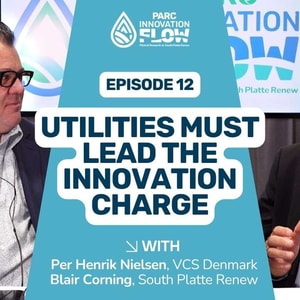
S1E12 -Utilities Must Lead the Innovation Charge
Transcript
All right, welcome everyone to the Innovation Flow podcast. We are live on the exhibition floor at weftec in Chicago 2025 and I am here with a very distinguished guest, Per Nilsson. Thanks for being here, Per.
Speaker B:Thank you. It's a pleasure.
Speaker A:And you are from VCS Denmark, right?
Speaker B:Yeah, I'm from BGS Denmark. Traveling a long way to get here.
Speaker A:Yeah. Well, thanks for coming by. You might be. You might win for the longest distance guest.
Speaker B:Guest Pub Singapore is beating me.
Speaker A:Oh, yeah. Okay. All right, well, maybe could you start by giving us a little bit about your background and what your experience in the industry is?
Speaker B:Yeah, I've been, as everybody can see, I've been around for a long time. So I've been working in wastewater treatment for the past 40 years in different positions. But lately for VCS for the past 20 years, my role in the company is leading the innovation on the wastewater side and looking for new opportunities, looking for how we can future proof the treatment plan and what we should see of challenges in the future.
Speaker A:Yeah, I remember South Platte Renew. You helped us as we got into the innovation, got our innovation program going and we held some conference calls and you kind of led some guidance to us and we appreciate that. Why do you think it's important to innovate in the industry and to help others innovate?
Speaker B:I think we are a community and I think that we cannot expect vendors to come up with all the innovation because they have their own agenda and rightfully so. They want to come up with an idea and see if it flies and they can sell it. Consultants, likewise, they have their own agenda, of course, because they want to make a business out of it. But we have an obligation, a public obligation for innovation because if we are not asking for innovation and driving innovation, the driver is not there. So there won't be any possibilities for consultants and for suppliers if we do not have this pull to get innovation. And another thing is, who else should do it if not us? I mean, we cannot expect somebody come from above and give us innovation. So we better get our act together and move in innovation and do better. We have a stressful environment. The environment around us is stressed and we can do something about it. We have the ability and we have the knowledge to some extent and we have the network so we can share with each other.
Speaker A:Yeah, yeah, I love that philosophy, I love that attitude and I love what you're doing there at vcs. Can you kind of. I read a lot of projects, but maybe you can give us a couple of your favorite innovative projects. That you've been working on there.
Speaker B:One of the bigger projects that we worked on and have been working on for many years and is still ongoing is to be energy positive, taking this energy consumption out of the equation and making us into an energy producer instead of energy consumer. And that's a long pull because it's not something that comes easy. You have to turn everything around and you have to be very focused on reducing electricity and heat usage and at the same time maximize the production. So right now we are producing more energy than what we are consuming. And we are happy that we can do that and get some resources, some very basic resources out of the wastewater, because reuse is not on the agenda for us. We have plenty of water. I know that's the problem in other places, but energy nexus is important for us.
Speaker A:Nice. Why do you think, from what I've seen, and correct me if I'm wrong here, but it seems like your facilities in Europe, Denmark, that area are a few years ahead of us here. Why do you think that is or do you think that is?
Speaker B:I think that a lot of American utilities are catching up now, which is really good to see. I think we've been ahead because simply because we are more congested than many areas in the US. Denmark is a small country. We have 6 million people, we have 11 million pigs, and that's a high environmental pressure. So there has been an early need for interaction and for doing something. We had water bodies that were not so good and we still have that, but. But we have been able to improve some of our rivers and receiving water, and that was really necessary. So it was driven by necessity in the first place. And that sparked innovation because if you get a requirement saying that you have to go for full B and R and it's not on the market, you have to be innovative. Right now we are looking into more stringent requirements and we have again, a pull in trying to be more innovative. And new challenges like emission is coming up on the agenda, both for methane and for nitrous oxide, which we've been working on quite some years now as well.
Speaker A:Yeah, that seems to be one of the hot topics or hot areas people are looking into. Is that nitrous oxide, methane emissions. That's good. What about. I've never been to Denmark. I would love to go.
Speaker B:Yeah, you should.
Speaker A:Yeah, I should. What can you tell us what? Some things about Denmark that people might not know or some exciting things there.
Speaker B:One of the things that is related a little bit to our talk today is that we have been very Progressive on renewable energy. So we have a lot of wind farming and solar power as well, despite the fact that it's dark half of the year. So our grid is relatively decarbonized, meaning that we are looking into new challenges compared to many utilities in the US because our biggest emission factors now are not the CO2 print from the electricity consumption, but it's more process oriented. So it's nitrous oxide that is problem and we have a variation in energy prices that varies every hour. So therefore we are seeing new challenges in adapting to a new electricity infrastructure.
Speaker A:Yeah. Cool. Well, how has your conference been here in Chicago? Have you been enjoying the conference? Done anything exciting while you're here?
Speaker B:Met a lot of people. I've been coming to Wevtec for the past, I think 12 years now and worked with a lot of utilities and organizations in the US Amongst others. And networking is a big part of it. Seeing the old friends and network and talk and hear what's new and see what's new, meeting up with them is I think the key. The exhibition is overwhelming as always and the conference program is really solid and I could spend a lot more time participating in more conference proceedings.
Speaker A:Yeah. Between the technical talks and then just walking around the showroom, it's. There's a lot to take in.
Speaker B:Yeah. And I'm surprised to see how many different colors you can get a pump in.
Speaker A:Yeah, yeah, that's true. I looked at your bio and I saw a few years ago you did the master lecture here at Webtech, is that correct? Can you tell, tell listeners, viewers a little bit about the master lecture, what it's about and what, what your topic was?
Speaker B:Yeah, it's quite some years ago now, so I haven't revisited it lately.
Speaker A:You forgot the topic.
Speaker B:But I'm sure that I pointed out the importance of cooperation and innovation and having this ability to run a risk. Because it is of course a little bit of a risk, or not even a little bit, but it's risky and you have to have the willingness to run the risk and understand that not all innovations will work out. We've been working on pyrolysis for many years. We're hopefully getting there and we're getting closer. But we have been disappointed in the fact that it didn't move faster. So that's one of the innovations that we have been struggling more with than others. We installed vacuum degassing on our sludge system in one of our treatment plants. Worked perfectly, nearly perfectly, but was a very, very positive experience. The same with the energy profiling and energy consumption project. But you have to understand that utilities, we see an obligation in running a risk and taking a calculated risk, but understanding that not everything will go the right way. And I've been very fortunate that they haven't sacked me yet for being too risky, taking too much risk.
Speaker A:Yeah. How do you find that balance? Is there a trick to finding it or you just get an intuition from your years of experience?
Speaker B:It has a lot to do with commitment to the sector and to doing something good for the environment. Because if we were not here, it would be a problem and we can do better and we should put our minds together and try to do better. And then of course, commitment from our top management and a willingness to let us fail sometime and not be only success stories. Accepting that if we take advantage of the new technologies before everybody else, we will see more problems. But it's challenging and it's more fun than just going through the motion. And we have a great group of staff that are willing to go an extra mile for trying new stuff.
Speaker A:We've learned the same thing through some of our piloting. You hear about the successes, but behind those there's two or three that fizzled out that you learned a lot from but didn't work out.
Speaker B:Yeah. And sometimes things. The world is changing. We saw a big problem in getting rid of our biosolids and therefore we engaged in pyrolysis plans and building that and developing that. We are not in a situation where it's a problem yet. So now the boundary conditions have maybe moved a little bit and haven't been going in the direction that we thought of initially.
Speaker A:Can you tell the viewers a little bit who aren't familiar with pyrolysis? Kind of a quick and dirty on what that means?
Speaker B:Yeah, Pyrolysis is a way of. For us it was a way of getting the moisture out of the biosolids in a way where we could reduce the moisture content in an energy neutral way. So it consists of a dryer and a pyrolysis oven followed by a pyrolysis oven where we gasify. So we burn the. We convert the carbon source in the biosolids to a gas without adding oxygen in it and that produces a syngas that we can use for heating the dryer. And it leaves us with a product that is dry and storable and easy, easier to handle. Legislation has not followed us. So we are still having issues in getting rid of it. Because it's a new product and getting there, it has some potential benefits. PFAS Reduction seems to be a possibility. At the site where we have pyrolysis, we don't have a big PFAS problem. So we don't have PFAS in our biochar, but we didn't have it in the biosolids either. So whether we reduced anything is hard to say, but that's another positive possibility.
Speaker A:That's interesting. You talked about your organization and your people willing to go the extra mile and lean into innovation. How do you do that? What's the secret to get in your organization to embrace innovation, to think a little bit differently than utilities maybe have in the past.
Speaker B:I think the key to that is to get the right people and having fun together and trusting each other, being good friends and. And at the same time being willing to engage people. Not unnecessary on their skill when we first get them into the company, but more on the attitude towards their work. So having a good playmate in the company is worth a lot. And the skills that are needed can always be developed to some extent. So I think. I think it has a lot to do with the human factor in there and then promoting champions in the company, having the possibility to go. I have a colleague coming with me here today and having this possibility to do things that are out of the ordinary. And that's very important.
Speaker A:Nice. Well, I want to thank you again for visiting us on the Innovation Flow podcast today. It was an honor talking to you. I've always enjoyed following what BCS Denmark and you are doing there. So thanks again for being on the show. Did you have anything to close out with you wanted to leave listeners with? Yeah.
Speaker B:I think that I'd like to thank you for the opportunity because I think that, that what we are doing here today is really important for the industry and for the innovation and for the networking. If we see each other and we can help each other and we can reach out to each other, we will be better at what we are doing.
Speaker A:Awesome. Well, thanks Per, and to our listeners and viewers, thanks for watching the Innovation Flow podcast. If you like the podcast, give us five star rating on whatever podcast or viewer you're watching on. And if you have any comments, reach out to us at Innovation Flow Podcast and let us know what you think. Thanks again, Per. And we'll see you next time on the Innovation Flow Podcast.
Episode Notes
In this live episode from WEFTEC 2025, we sit down with Per Henrik Nielsen of VCS Denmark, a distinguished leader with 40 years in wastewater innovation. Per shares our belief that public utilities have an obligation to drive change where vendors and consultants cannot. Learn how VCS Denmark became an energy-positive utility, the challenges and calculated risks involved in pursuing ambitious projects, and why fostering an organizational culture built on trust and a "willingness to fail" is key to the future of water.
Find out more at https://parc-innovation-flow.pinecast.co